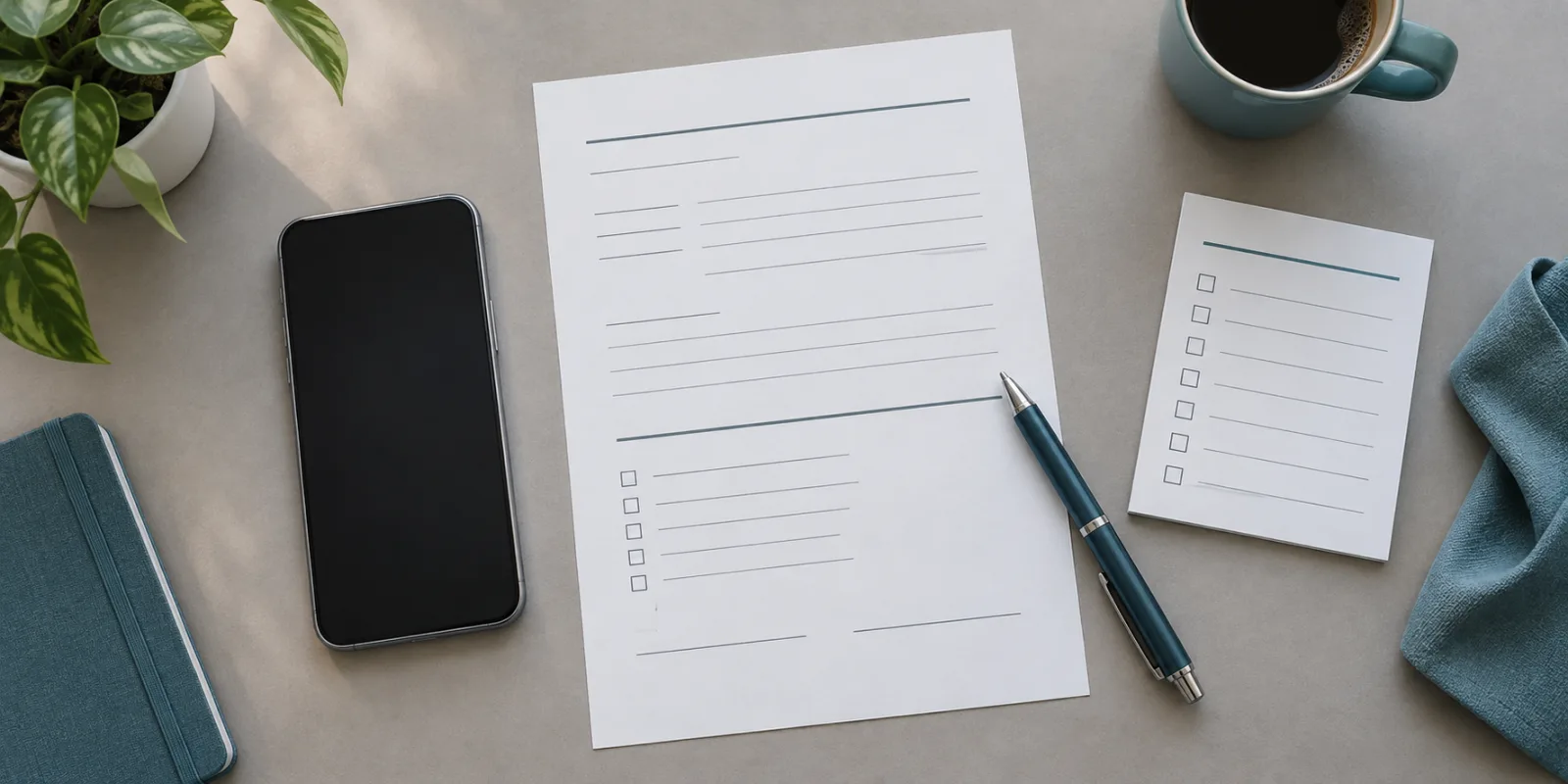
Key facts
- A used phone sale agreement records the device, condition, price, ownership promises, account-lock status, and transfer details for a private sale.
- Record the exact make, model, storage, color, serial number, and IMEI or MEID before payment.
- Have the seller remove activation locks and accounts while the buyer is present.
A used phone sale agreement records exactly which device changed hands, what the seller disclosed, how much the buyer paid, and when ownership was transferred. Use the template below for a private, one-time sale, then adapt it to the law and marketplace rules that apply where the transaction takes place.
Important: this is a practical documentation template, not legal advice. A written agreement cannot make a stolen, financed, blacklisted, or account-locked phone safe to buy, and it cannot remove rights or duties that local law makes mandatory.
Quick answer: what to put in the agreement
- Record the exact make, model, storage, color, serial number, and IMEI or MEID before payment.
- Have the seller remove activation locks and accounts while the buyer is present.
- Describe every known defect, repair, replacement part, included accessory, and remaining warranty in writing.
- State the price, payment method, delivery method, inspection result, and the exact date and time of transfer.
- Give both parties a signed copy and keep the listing, messages, payment record, and condition photos with it.
The agreement is evidence of what both parties said and accepted. It is not a substitute for testing the phone, checking ownership and finance status, or confirming that the buyer can activate it.
Checks to complete before payment
Do not leave the important checks until after signing. Complete them while the seller still has the credentials and authority needed to remove locks or contact the carrier.
| Check | What to verify | Why it belongs in the record |
|---|---|---|
| Identity of the device | Model, capacity, color, serial number, and IMEI or MEID match the settings screen, packaging, and agreement | Prevents a different unit from being substituted |
| Ownership | Seller confirms they own the phone and have the right to sell it | Creates a written representation, but does not replace independent checks |
| Finance and carrier | No unpaid installment plan, lease, insurance claim, or carrier restriction that would affect the buyer | Some problems can appear after the sale if they are not resolved first |
| Account locks | Apple Activation Lock, Google account protection, screen lock, and manufacturer account are removed | A reset phone can still require the previous owner's credentials |
| Functions | Display, touch, cameras, speakers, microphone, charging, buttons, biometrics, Wi-Fi, Bluetooth, and cellular connection | Turns vague condition claims into an inspection record |
| Repair history | Known repairs, liquid exposure, replacement parts, battery condition, and unresolved faults | Material facts can affect value, safety, and future repair options |
If a seller will not let the buyer compare identifiers, test activation, or document known defects, pause the transaction. A low price does not compensate for a phone that cannot be activated or legally transferred.
Information to collect from buyer and seller
Collect enough information to identify the parties and the transaction without creating an unnecessary identity-theft risk. Common fields are full legal name, contact method, city or region, and signature. Local law or a payment provider may require more.
Do not publish the completed agreement, identity document, address, signature, serial number, or full IMEI in a public listing. Each party should keep the signed copy securely. If an identity document is checked in person, record only what local law permits and what is genuinely needed.
Copy-and-paste used phone sale agreement
Copy this template into a document editor. Remove any optional clause that does not match the transaction, fill every blank, and have both parties initial handwritten changes. To create a PDF, use the editor or browser Print command and choose Save as PDF.
USED PHONE SALE AGREEMENT

1. PARTIES
Seller legal name: ______________________________
Seller contact: __________________________________
Buyer legal name: _______________________________
Buyer contact: ___________________________________

2. DEVICE
Manufacturer and model: __________________________
Storage and color: _______________________________
Serial number: ___________________________________
IMEI or MEID: ____________________________________
Carrier or network status: ________________________

3. INCLUDED ITEMS
Phone, accessories, box, and documents included:
__________________________________________________

4. CONDITION AND DISCLOSURES
Known defects, damage, repairs, replacement parts,
battery information, and missing functions:
__________________________________________________
__________________________________________________

5. OWNERSHIP AND ACCOUNT STATUS
The seller states that the seller owns the device,
has the right to sell it, and has disclosed any
finance, lease, insurance, carrier, or ownership
issue that could affect the buyer.

Apple, Google, manufacturer, and screen locks have
been removed:  Yes / No / Not applicable

6. PRICE AND TRANSFER
Price and currency: _______________________________
Payment method: __________________________________
Transfer date and time: ___________________________
Delivery or collection method: ____________________

7. INSPECTION AND WARRANTY
Buyer inspected the device:  Yes / No
Functions tested or not tested: ___________________
Seller warranty, if any: __________________________
If none is promised, state the agreed condition and
legal wording permitted in your jurisdiction:
__________________________________________________

8. ENTIRE RECORD
Attachments: listing, photos, test checklist,
payment receipt, repair records, other: ___________

9. GOVERNING LOCATION
Country, state, province, or region: ______________

10. SIGNATURES
Seller signature: __________________ Date: _________
Buyer signature: ___________________ Date: _________
Witness, if used: __________________ Date: _________
Do not sign with blank fields. Mark unused fields as "not applicable" so information cannot be added later without being obvious.
Describe the exact phone and accessories
Use the model name shown in device settings, not only the marketing name from the listing. Record storage capacity and color, then compare the serial number and IMEI or MEID across the phone, original packaging, carrier records, and any purchase document that is available. Dual-SIM devices can have more than one IMEI, so record each relevant identifier.
List every included item separately: cable, power adapter, case, stylus, removable memory card, original box, purchase receipt, and repair paperwork. Do not write "all accessories" unless both parties have an identical, attached list.
Document ownership, finance, and carrier status
The seller should state that they own the phone and have authority to transfer it. The agreement should also ask about an installment plan, lease, carrier subsidy, insurance replacement, theft or loss report, and any other claim against the device.
A clean check today is useful but not an absolute promise about tomorrow. A carrier, insurer, or rightful owner may later report a problem based on information the buyer cannot see. When possible, complete the transaction through a marketplace with seller verification and buyer protection, or verify the status directly with the relevant carrier before payment.
Write down condition, repairs, and defects
A phrase such as "good condition" is too vague. Describe cracks, scratches, dead pixels, touch faults, weak battery life, camera problems, charging-port wear, liquid exposure, missing screws, biometric failures, non-original parts, and previous repairs. Note whether the phone has been opened and whether any repair warning appears in settings.
Condition photos should show the powered-on screen, front and back, frame, cameras, ports, and identifiers without publishing them publicly. Save the original files with their timestamps and attach a short index to the agreement.
Record price, payment, and delivery
Write the numeric amount, currency, payment method, and whether payment is complete. For a bank transfer or marketplace payment, save the transaction reference without exposing unrelated account data. For cash, include a signed statement that the seller received the full amount.
For an in-person transfer, record the date, time, and place. For shipping, state who pays, the service level, tracking number, signature requirement, insurance, dispatch deadline, and the procedure if the package arrives damaged or does not match the description. Photograph the phone's condition and packaging before dispatch.
Use an inspection and acceptance checklist
Test the phone before erasing it if the seller can demonstrate functions without exposing private data. Then erase it properly and complete enough setup to prove that it is no longer linked to the seller. A practical inspection includes:
- Display brightness, touch response, dead pixels, and screen rotation.
- Front and rear cameras, flash, speakers, microphones, vibration, and physical buttons.
- Charging by cable, wireless charging when supported, and visible battery-health information.
- Wi-Fi, Bluetooth, GPS behavior, SIM recognition, calls, and mobile data where a test SIM is safe to use.
- Face, fingerprint, stylus, memory-card slot, and other model-specific functions.
- Setup after erasure without a request for the previous owner's Apple, Google, or manufacturer credentials.
Mark anything that was not tested. "Not tested" is clearer than silently implying that every feature works.
Choose warranty or as-is wording carefully
The parties can record whether the seller promises a limited testing period, a specific repair, or no voluntary warranty. Do not copy an "as is" clause from another country and assume it cancels mandatory rights. The legal effect depends on the location, whether the seller is genuinely private or acting as a trader, and what was represented about the phone.
Official EU guidance says goods bought from private individuals are not covered by EU consumer rules, while second-hand goods bought from professional traders are covered. Australian guidance similarly says most consumer guarantees do not apply to one-off private sales, although some title protections remain. These examples show why the agreement must name the location and why repeated commercial sellers should use business-specific terms.
Remove Apple and Google account locks
For an iPhone or iPad, Apple advises buyers not to take ownership while Activation Lock remains enabled. The seller should follow Apple's transfer steps, erase the device, and remove it from the Apple Account. The buyer should continue setup far enough to confirm that the previous owner's credentials are not requested.
On Android, remove the seller's Google and manufacturer accounts through Settings before the factory reset. Google documents that removing an account deletes the associated email, contacts, and settings from that device. Reset instructions and theft-protection behavior can vary by manufacturer, so use the official support page for the exact model.
Never ask the seller to reveal an Apple Account or Google Account password. The seller should enter credentials privately and remove the lock themselves.
Protect personal data, SIMs, and eSIMs
The seller should back up needed data, sign out of accounts, transfer authentication apps and passkeys, remove payment cards, erase the phone, and remove physical SIM and memory cards. An eSIM plan may also need to be erased or transferred with carrier help. The buyer should not accept responsibility for preserving data left on the device.
The buyer should perform the initial setup with their own account and SIM only after the seller's accounts are removed. Both parties should treat any data accidentally left on the phone as private and arrange secure deletion rather than copying or browsing it.
Add safeguards for an online or shipped sale
Keep communication and payment inside the marketplace when its protection depends on doing so. Avoid requests to move immediately to an unprotected payment method. Save the final listing, seller profile, messages, device identifiers, tracking record, and unboxing evidence.
The agreement should say when risk of loss passes from seller to buyer, who files a carrier claim, and how the buyer reports a mismatch. Do not use a generic template to contradict the marketplace's binding terms. If platform rules and the private agreement conflict, obtain local advice before relying on either.
Stop the purchase when these red flags appear
- The identifier in Settings does not match the box, receipt, or agreement.
- The seller refuses to remove Activation Lock, Google protection, a screen lock, or a manufacturer account.
- The phone is still financed, leased, managed by an employer or school, or tied to an unresolved insurance claim.
- The seller will not allow activation, basic tests, condition photos, or a written receipt.
- The payment request is urgent, irreversible, or outside the marketplace that introduced the parties.
- The price is implausibly low and the ownership story or documents are inconsistent.
Do not try to bypass an account lock or change a device identifier. Return the phone to the seller or use the marketplace dispute process while its deadline is still open.
What each party should keep after signing
Each party should keep the same final agreement, listing, messages, payment proof, photos, test checklist, shipping record, and any repair or purchase documents. Store them securely for the period required by local law, payment rules, taxes, warranties, or marketplace disputes.
If a disagreement arises, communicate in writing and identify the exact clause, disclosure, photo, or test result in dispute. Preserve the device and records before attempting a repair, chargeback, carrier report, or legal claim.
Frequently asked questions
Do I need a contract to sell a used phone?
A formal contract may not be legally required for every private sale, but a signed record is useful evidence of the device, condition, price, disclosures, and transfer. Local rules decide what is required and what effect the document has.
Is this the same as a phone bill of sale?
The names are often used interchangeably for a private transfer record. "Bill of sale" may have a specific legal meaning in some places, so use the label and required terms recognized in your jurisdiction.
Should the IMEI be written in the agreement?
Yes, recording the relevant IMEI or MEID helps identify the exact phone. Keep the completed document private and do not post the full identifier in a public advertisement.
How do I save the agreement as a PDF?
Copy the template into a document editor, complete it, then use Print or Export and choose PDF. Review the saved file before signing to make sure no field or page was cut off.
Does a private seller have to give a warranty?
There is no universal answer. It depends on local law, whether the seller is actually acting as a business, the statements made about the phone, and any written promise. Do not rely on a generic "no warranty" sentence to override mandatory rights.
What if the phone becomes locked after the sale?
Contact the seller and the marketplace or payment provider promptly, preserve the agreement and evidence, and ask the relevant carrier or manufacturer what status changed. Do not pay a third party to bypass the lock or alter the IMEI.
Sources and scope
This guide was reviewed on October 14, 2026 using official Apple guidance for buying a pre-owned iPhone, Apple's seller transfer checklist, Android Help for removing an account and factory resets, the FCC's device identifier advice, and current second-hand-sale guidance from the European Union, UK government, and Australian Competition and Consumer Commission. The template remains general and must be adapted to the law, marketplace rules, and facts of the transaction.