Key facts
- Diagnose SP Flash Tool errors safely, including 8417, 8038, 5054, invalid DA, DA stage 1, BROM, PMT, DRAM, USB, and storage failures.
- Record the complete message.
- Save the numeric code, symbolic name such as S_FT_ENABLE_DRAM_FAIL, and the stage or percentage at which the operation stopped.
SP Flash Tool errors usually identify the stage at which a MediaTek device stopped communicating with the computer: opening the USB port, loading the scatter or XML package, sending the download agent, initializing DRAM, comparing the partition map, or writing storage. The safest fix is to identify that stage first, not to format the phone or replace files at random.
Before you continue: flashing can erase user data, and destructive modes can also remove device-specific calibration or security data. Use firmware, a download agent, authentication files, and a preloader made for the exact model, hardware revision, and storage variant. If you cannot prove that match, stop before formatting or flashing the preloader.
Before fixing an SP Flash Tool error
- Record the complete message. Save the numeric code, symbolic name such as
S_FT_ENABLE_DRAM_FAIL, and the stage or percentage at which the operation stopped. - Confirm the exact device variant. Model names can cover different chipsets, memory sizes, storage types, and regional boards. A visually identical phone may need a different package.
- Use the manufacturer's service package. Extract the complete archive into a short local path. Do not mix a scatter, preloader, download agent, or authentication file from another package.
- Back up what is still accessible. Formatting, changing the partition map, or unlocking a bootloader may erase data.
- Start with Download Only when the vendor's instructions allow it. Do not choose Format All + Download simply because a forum post says it clears an error.
MediaTek's current download-mode documentation describes a chain: the host detects the SoC, sends a compatible download agent to SRAM, and only then transfers images to storage. That is why a cable problem, an incompatible agent, a wrong preloader, and failing storage produce different families of errors.
Find the failing stage first
| Where it fails | Typical message | Check first |
|---|---|---|
| Before a progress bar appears | COM port open, BROM start, no device | Device Manager, cable, direct USB port, boot key sequence, vendor driver |
| When selecting a package | 8417, scatter invalid, please load scatter file | Complete archive, correct file type, exact platform, simple local path |
| While sending the agent | invalid DA, unsupported DA, DA stage 1 sync/send failed | Tool generation, package-provided DA, secure-device authorization |
| At DRAM initialization | 5054, 4032, EXT_RAM errors | Exact preloader/EMI data, board and memory variant, possible hardware fault |
| Before partition writing | 8038, PMT changed, need download all | Firmware partition layout versus the device's current layout |
| During a write or readback | 4008, 4009, 3149 | Stable power and USB, free disk space, storage health, log file |
Five-minute non-destructive checklist
- Disconnect the device, close SP Flash Tool, and reopen the version supplied or recommended by the device manufacturer.
- Move the fully extracted tool and firmware folders to a short path that contains only ordinary Latin letters and numbers, for example
C:\MTK\MODEL\. - Use a known-good data cable and a USB port directly on the computer. Avoid hubs, docks, and front-panel extensions during diagnosis.
- Open Windows Device Manager, start the operation in SP Flash Tool, then connect the powered-off device using the manufacturer's button sequence. Watch whether a MediaTek port appears, disappears, or shows a Windows problem code.
- If Windows reports a driver problem, follow Microsoft's Device Manager guidance and use the device manufacturer's driver package. If the port is detected normally and the error occurs later, do not keep treating it as a driver failure.
- Reload the untouched scatter/XML and DA from the same firmware package. Do not hand-edit partition addresses to silence an error.
If the failure repeats at exactly the same later stage with two known-good cables and ports, focus on package compatibility, security authorization, DRAM initialization, or storage, not the USB driver.
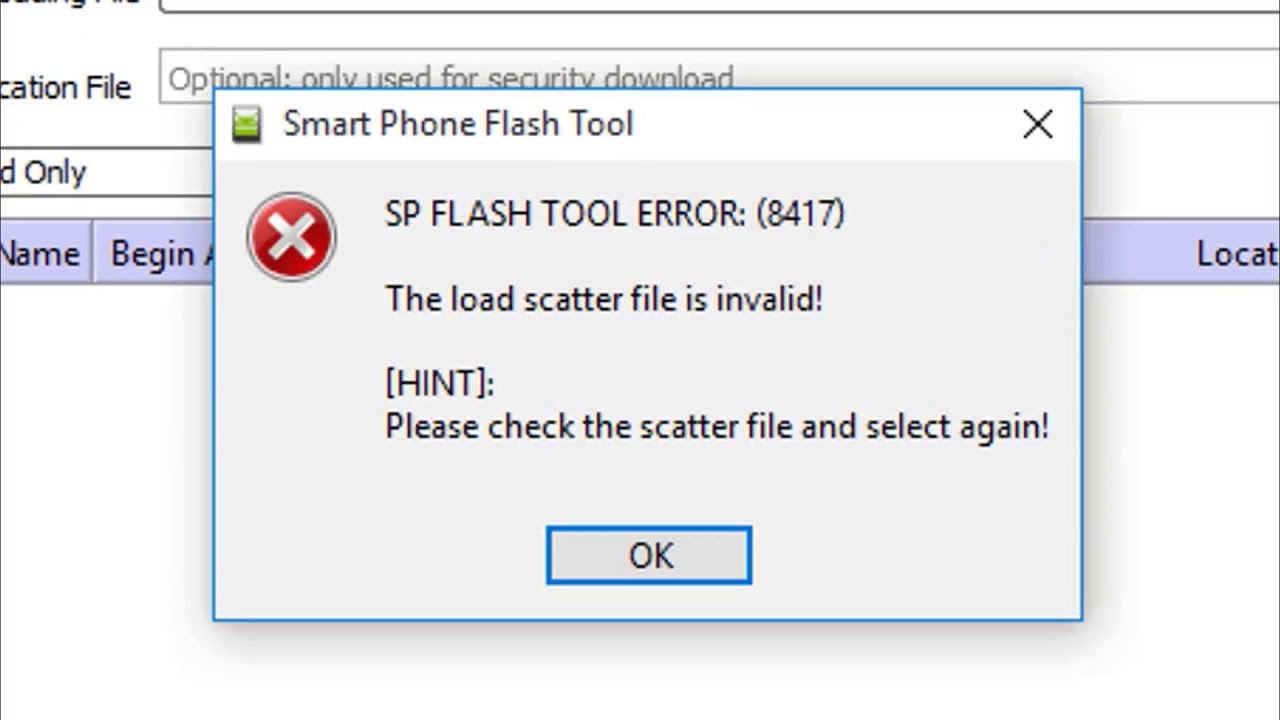
SP Flash Tool error 8417 / 0x20E1
What it usually means: SP Flash Tool could not initialize or parse the selected scatter file. The file may be incomplete, edited, intended for another tool generation, or paired with a platform that the running tool does not support.
Safe checks for error 8417
- Extract the firmware archive again; do not open a scatter directly from a ZIP/RAR preview.
- Make sure you selected the package's scatter file rather than a preloader, image, checksum file, or similarly named text file.
- Confirm that the chipset named inside the scatter belongs to the exact device board.
- Keep the original file name and content. A short ASCII-only folder path is a useful compatibility test for legacy builds.
- If the package is designed for SP Flash Tool v6 and contains
flash.xmlor another download XML, follow that package's v6 instructions instead of forcing it into a v5 scatter workflow.
Do not download an unrelated scatter file just because it has the same chipset number. Partition addresses can differ between storage capacities and board revisions.
SP Flash Tool error 8038: PMT changed for the ROM
What it means: the partition map in the selected firmware does not match the partition map currently stored on the device. This can be legitimate during an official full upgrade, but it can also reveal a wrong model, storage SKU, board revision, or incomplete firmware package.
What to do before changing the partition map
- Verify the full model code and storage capacity from the label, box, recovery screen, or original documentation.
- Confirm that every firmware component, including the scatter, preloader, and images, came from the same OEM package.
- Check the manufacturer's flashing instructions. Use Firmware Upgrade only when the official package explicitly calls for it.
- If you only intended to flash one partition, stop. A PMT mismatch is not a reason to format the entire device just to write a custom recovery or boot image.
Why “Format All” is risky: it may erase the partition table and device-specific data before you know whether the package can boot the hardware. A successful format followed by a failed download can leave the device harder to recover.
SP Flash Tool error 5054: S_DL_GET_DRAM_SETTINGS_FAIL
What it usually means: the download agent could not obtain or apply valid DRAM initialization settings. On many legacy packages, those settings are tied to the preloader/EMI configuration and therefore to the exact board and memory chips.
Safe checks for error 5054
- Confirm the firmware is for the exact hardware and RAM/storage variant, not merely the same marketing name or MediaTek SoC.
- Use the preloader and download agent that belong to that complete package. Do not substitute a generic or random DA.
- If Windows detects the BROM/Preloader port and the tool reaches the DRAM stage, repeatedly reinstalling USB drivers is unlikely to fix a package mismatch.
- Try one known-good cable and a direct USB port to exclude a connection drop.
- If a verified OEM package fails on the same device while working on identical hardware, suspect damaged RAM, storage, power, or board-level hardware and stop repeated writes.
Invalid DA version, unsupported DA, and error 5002
The download agent is executable code sent to the MediaTek SoC during the flashing handshake. An invalid DA, unsupported DA version, or S_INVALID_DA_FILE (5002) message means the selected agent is not accepted by the tool, platform, security configuration, or firmware package.
- Return to the untouched DA included with the exact OEM service package.
- Use the SP Flash Tool generation specified for that package. Do not assume the newest executable supports every legacy package, or that an old v5 build supports a modern v6 workflow.
- For a secure device, obtain the authorized DA and authentication file through the manufacturer or authorized service channel. A normal generic DA cannot replace required authorization.
- Do not rename an arbitrary binary to look like a DA file.
DA stage 1 sync/send errors and BROM connection failures
Messages such as failed to send DA stage 1, DA stage 1 sync error, S_BROM_CMD_STARTCMD_FAIL, or S_BROM_CMD_JUMP_DA_FAIL occur before normal partition writing begins. Use the point of failure to separate transport problems from authorization or package problems.
- Watch Device Manager while connecting the powered-off device. A port that never appears points to the cable, port, button sequence, driver, battery/power state, or hardware.
- A port that appears and then fails when the DA is sent points more strongly to an incompatible DA, tool generation, secure-boot requirement, or wrong target package.
- Follow the exact boot-key or test-point procedure published for the device. Do not short random board contacts.
- Close other phone, modem, and serial-port tools that may claim the same COM device.
Other common SP Flash Tool error codes
| Code / message | Likely failure area | Safe next step |
|---|---|---|
1003 / 1013S_COM_PORT_OPEN_FAIL | The tool cannot open the selected USB/COM device. | Close other serial tools, reconnect through a direct port, and inspect Device Manager. |
1011S_NOT_ENOUGH_STORAGE_SPACE | An image does not fit the target region or host-side space is insufficient. | Check the exact firmware/storage variant and free computer disk space; do not resize images blindly. |
1022S_UNSUPPORTED_VER_OF_DA | DA and tool/platform versions are incompatible. | Use the OEM package's matching tool and DA. |
| 1040 / 8200 unsupported operation/platform | The selected package does not match the target platform or requested operation. | Reconfirm the SoC, board revision, package, and official flashing method. |
| 3012 / 3144 NAND/eMMC not found | The agent cannot detect the expected storage. | Verify the storage type and package; if correct, suspect storage, power, soldering, or board damage. |
3149S_DA_SDMMC_WRITE_FAILED | A storage write failed. | Check power, cable, port, and the log. Repeated failure at the same address can indicate worn or damaged storage. |
4008S_FT_DOWNLOAD_FAIL | The download stopped during transfer. | Charge the device if applicable, use a direct port and known-good cable, then review the log for the last completed stage. |
4009S_FT_READBACK_FAIL | Readback failed on the device or while writing the output file. | Check host free space and permissions, cable stability, requested address range, and storage health. |
4032S_FT_ENABLE_DRAM_FAIL | The agent could not initialize DRAM. | Treat it like 5054: verify the exact preloader/EMI package and hardware before any format. |
4050S_FT_NEED_DOWNLOAD_ALL_FAIL | The requested partial download conflicts with the stored partition layout. | Verify the complete OEM upgrade path; do not select all partitions until the package match is proven. |
| 5066 invalid GFH/file information | The selected image or preloader metadata is not valid for the operation. | Restore the untouched file from the complete OEM package. |
6124S_SECURITY_INVALID_PROJECT | Security/project identifiers do not match the target. | Use the exact authorized service package; do not try to bypass project authentication. |
| 8045 | A partition-layout or storage operation failed and the legacy numeric label alone is not diagnostic enough. | Save the full log, verify the package, and use authorized service tools if the device cannot identify storage or boot. |
What to collect before asking for help
- Exact brand, model code, hardware revision, RAM/storage capacity, and chipset if independently verified.
- SP Flash Tool version and whether the package uses a scatter file or download XML.
- The complete error code, symbolic name, progress percentage, and log, not only a cropped popup.
- Firmware source and exact build identifier.
- Whether the MediaTek port appears in Device Manager and whether it has a Windows problem code.
- Which operation was selected and whether preloader, format, or partition-map changes were attempted.
Remove serial numbers, account identifiers, tokens, and other personal data before posting logs publicly.
When to stop troubleshooting
Stop repeated flashing attempts when the only available firmware is for a similar but not identical model; the tool requests authorization you do not have; a verified package repeatedly cannot initialize DRAM or detect storage; the board overheats; or the device disconnects under stable power with multiple known-good cables. At that point, an authorized repair service with the correct package and board-level diagnostics is safer than additional formatting. Android's own flashing documentation also warns that unlocking can erase user data and recommends changing the USB cable or port when communication is unreliable.
Frequently asked questions
Should I always install the newest SP Flash Tool?
No. Use the version or generation specified by the device manufacturer's service package. MediaTek's current v6 documentation and legacy scatter-based v5 workflows are not interchangeable.
Does Format All + Download fix every PMT or DRAM error?
No. It can erase data and device-specific configuration without fixing an incompatible package, DA, preloader, memory variant, security requirement, or hardware fault.
How do I know whether it is a driver error?
If no MediaTek USB/COM device appears, or Windows shows a Device Manager problem code, troubleshoot the connection and vendor driver first. If the port opens and SP Flash Tool reaches DA, DRAM, PMT, or storage stages, the driver has already done part of its job and the later error needs stage-specific diagnosis.
Where should I download SP Flash Tool and firmware?
Prefer the device manufacturer's support or authorized service package. MediaTek publishes current tools and documentation for its Genio development platforms, but that does not make a Genio image or DA suitable for a consumer phone. Be cautious with sites that describe themselves as “official” without a MediaTek or device-vendor domain.
Sources and scope
This guide was reviewed on October 12, 2026 against MediaTek's current flashing documentation, Microsoft's Device Manager guidance, and the Android Open Source Project's flashing safety notes. MediaTek does not publish one current public manual for every legacy phone error code listed here, so the code sections describe safe diagnostic boundaries rather than guaranteed fixes for every device.